O que entra pela boca – Um diálogo sobre dietas e educação alimentar
Este artigo é resultado de uma entrevista feita por Liliane Oraggio, jornalista, e Regina Favre, psicoterapeuta corporal, para uma revista especializada em fitness, de grande circulação. A pauta era a Autossabotagem na Dieta: quais as razões que levam a perder o limite do que se come ou a simplesmente esquecer a idolatrada contagem de calorias? O processo formativo norteou a conversa que evidencia vários comportamentos ligados à alimentação (e a mudança dela), para muito além das idealizações, da ditadura da beleza e da obsessão por regimes.
Liliane Oraggio – O que está por trás do compromisso de fazer uma dieta?
Regina Favre – Inicialmente, a gente põe comida para dentro para fazer corpo para dar prosseguimento ao destino de o corpo prosseguir se fazendo, do começo ao fim da vida. A primeira coisa que acontece quando a gente se desliga da placenta é precisar de alimento pela boca. O que vinha pelo umbigo passa a vir pela boca pelo resto da vida. E uma dieta pode dizer mil coisas. Pode atender uma necessidade da saúde, em primeiro lugar. É uma modificação daquilo que a gente põe para dentro para fazer corpo. O corpo se faz com as proteínas e elementos que vem basicamente pela alimentação, pode-se fazer músculo como pode fazer gordura, como pode fazer doença, disfunções.
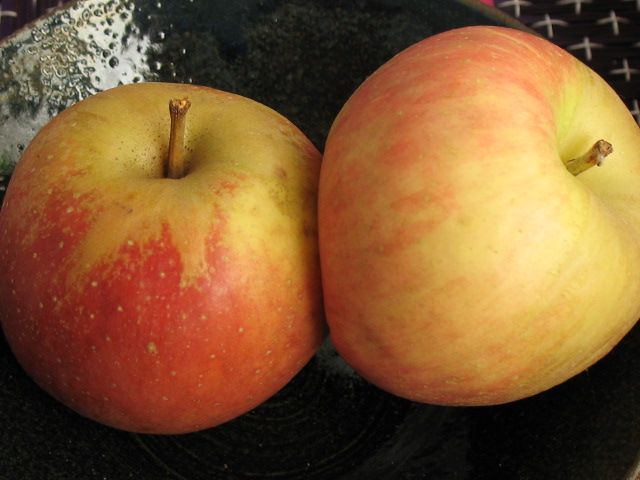
Existem muitas outras questões que vêm junto com uma noção de dieta. As modas são muito fortes, modelos de corpo que podem ser realistas ou muito idealizados. Como se o corpo fosse um sapato novo, um vestido novo. Então vou comprar um tamanho 36, vou passar a usar de 46 para 42, como se fosse moda que você compra. Quanto mais uma pessoa se identifica consigo mesma e com uma realidade encarnada, corporal, mais ela tem a medida de como ela é e menos idealiza corpos para si.
LO– Então, podemos dizer que quanto mais próxima a pessoa estiver de sua própria realidade corporal mais bem sucedida será a dieta?
RF– Completamente. Porque assim a dieta vai ser realista. Primeiro, mudar alimentação é uma educação, que requer uma clareza de que aquilo que você come se transforma em corpo. Seja muito, seja pouco, seja certo, seja errado. Essa relação entre o que entra e o que forma é vivenciada apenas por quem tem uma história alimentar tranquila, sem pressão ou sem loucuras. Por exemplo, outro dia eu estava na padaria jantando. Entrou um homem enorme, gordo, grande, imenso, devia ter uns 40 anos. Ele estava com a filhinha, de uns 3 anos. Uma menininha normal. Ele disse para a garota: “Ô gorda, vamos fazer um prato de doces?”. Ele direto começou a encher um prato com pedaços de torta, de pudim, nem passou pela comida. Era hora do jantar. Fez um prato com muitas coisas. A menina deve ter chiado porque não estava com vontade de tanto, do excesso. Não ouvi o que ela disse, mas ele exclamou: “Mentira!”. Fiquei pensando o delírio que tinha ali, o quanto o doce estava ligado a um certo barato. Essa para mim foi uma cena elementar. Fiquei olhando aquele homem de 1,90m, tórax imenso, barrigudo, costas enormes. E uma criança que não tem nem como dizer não para esse pai .Ali era uma cena totalmente imaginária, do uso da comida para produzir um certo estado, um certo barato. E o homem transmitindo isso para a criança. A comida é vincular, a comida tem uma história, a alimentação é afetiva, tem a ver com a vida da pessoa. Comida é um hábito.
LO – Justamente, as pesquisas apontam que as pessoas esquecem de contar calorias ou cometem excessos justamente em momentos afetivos: jantando com o namorado, a mulher tentando acompanhar o apetite do marido, comendo toda a sobra de comida dos filhos. E porque é tão difícil lidar com alteração do cardápio?
RF – Sim, pode-se mudar a organização do cardápio, as porções de proteína, carbohidrato, gordura, em termos de substâncias. Mas, a comida, ao entrar no corpo, a produz um certo estado metabólico. A proteína dá uma certa resposta, o açúcar dá uma certa resposta, a gordura dá uma certa resposta. Respostas de energia, de algo conhecido, de saciedade, de memória. A comida remete a clima metabólico que é de memória, que é de paladar, que é de volume, de sensação interna de órgãos, sensação de boca. São sensações imemoriais e metabólicas. Mudar o cardápio altera um estado tão conhecido dentro da pessoa, que é difícil manter. A menos que tenha um cuidado específico. Uma mudança é uma coisa muito lenta e cuidadosa, porque está mudando um autoreconhecimento, um senso de si muito profundo. Achar que comida é uma coisa mecânica, que troca uma coisa por outra e tudo bem, não é verdade. E aí outro perigo, fazer isso de maneira rígida, mecânica, obsessiva, absolutamente compulsiva, pensando vou comer três disso, dois daquilo, e pronto. As pessoas tendem, principalmente as que malham, conseguem estabelecer com mais facilidade rotinas mais obsessivas e compulsivas, e a relação a contagem e gasto de calorias, números, fórmulas, com mais facilidade. Mas precisa ver o quanto esse é um ganho e o quanto é uma perda construir um corpo idealizado ou construir um corpo vivido. Apenas se abastecer de nutrientes ou comer de fato.
LO – E pode ter o efeito contrário: a obsessão pela dieta gerar a dificuldade de emagrecer?
RF – Isso acontece quando são estabelecidas metas inatingíveis. É a tal da idealização. Por exemplo, há pessoas que podem ter um comportamento alimentar diurno e outro noturno. É muito comum gente que ataca a geladeira à noite, como se fosse um sonâmbulo, e sai pela casa espalhando comida, ela chega a pisar em cima e não lembra, pois tudo foi ingerido em estado sonambúlico. Existe isso.
LO – É preciso ter paciência para emplacar uma dieta?
RF – Os hábitos em geral não são fáceis de serem modificados. Você tem que se apropriar daquilo que você faz, perceber como você faz o que faz, depois começar a introduzir variações e ver os efeitos que tem sobre você, então, o novo hábito começa a fluir. No hábito alimentar isso é mais intenso ainda, pois tem raízes muito profundas. Não existe organismo vivo na atmosfera que não se nutra de alguma coisa. Nutrição é uma função superbásica, não pode ser tratado de maneira mecânica, desligado da experiência emocional de ser quem você é.
RF – Existem dois aspectos extremamente perversos na nossa cultura de mercado:
1- A imagem das pessoas.
2- A quantidade de oferta de prazeres de comida.
99% das pessoas saem para comer juntas. Comer, beber está completamente relacionado com a sociabilidade. A amizade no homem se estabeleceu com a comensalidade, com o comer junto, que é o momento que os homens mostram que não são animais, que não usam os dentes para comer os outros, mas para comer a caça juntos. A amizade é baseada na comensalidade, totalmente ancestral. Tudo isso tem que ser levado em conta na hora que a gente come. Mas, por outro lado, as pessoas que são ditas “mais seguras socialmente” são as pessoas que assumem a imagem dos magros e malhados. Em festas chiques, com muita comida, é comum encontrar mulheres magérrimas, que comem uma folha de alface e passam a noite com uma taça de champanhe na mão, sem tomar nenhum gole. Então tem esse nível de distorção absurda.
LO – Isso me lembrou uma cena. Estava em um elevador cheio, uma mulher muito magra dona do tal corpo ideal, se orgulhava da estratégia que encontrou para manter a forma. Ela dizia que adora chocolates mas, para manter a forma, apenas punha o bombom na boca, sente o gostinho e cuspia tudo, em seguida. E falou isso com o maior orgulho, dando o bom exemplo.
RF – É uma dissimulação. É um jeito de se manter magérrima e incluída na coreografia do ambiente. Então, a mulher da festa por onde ela passava, estava mastigando, ninguém sabe se era uma folha do alface mas o quê. Ela faz o ritual do ambiente, mas perversamente.
LO – Num controle perverso?
RF -Totalmente perverso para o prazer, pois a comida está relacionada ao prazer à comemoração.
LO – E quando a pessoa está imbuída do compromisso de fazer dieta, está pensando nesses aspectos, mas esquece disso e comete excessos. Esses lapsos acontecem por que?
RF – Por que talvez ela tenha que praticar mais, aprender mais, ter mais paciência com ela mesma no processo de reeducação alimentar. Como quem começa a fazer ginástica, como quem pratica natação nem sempre faz as mesmas marcas. Não se pode ser obsessivo com comida, deve-se variar e ir acompanhando as variações e não se torturar pelos “erros”. Se esqueceu é por que algo mais forte estava ali.
LO – O que fazer com essa amnésia?
RF – Nada. Perdoa e volta para o propósito, pois quanto mais culpa tem, mais transgride, mais se desafia, mais faz escondido de si mesmo, mais tem ataques de compulsão, menos obedece a si mesmo.
LO – Você acha que as situações onde tem mais afeto colocam mais em risco isso?
RF – Não. Depende da inteligência alimentar que a pessoa tem. Existem pessoas que acham que afeto é se entupir de doces. São culturas familiares. Pode ter enorme prazer alimentar comendo coisas leves, que não deixam de barriga pesada, que tem sabores delicados, variados, sutis e não precisar comer uma feijoada para achar que está comendo uma coisa gostosa.
LO – E a sensação de vazio?
RF – A saciedade é algo a ser estudado. Tem pessoas que têm dificuldade muito grande em perceber a saciedade, isso requer um suporte um nutricionista ou de uma psicoterapia, pois esse pode ser um problema mais profundo, que não pode resolver por conta própria. Problemas profundos de saciedade podem estar relacionados com o funcionamento cerebral e até ser preciso usar medicações, como antidepressivos, que ativam ou inibem certas áreas do cérebro, sinalizando um limite. Em geral, essa questão da saciedade está associada a outras dificuldades de se sentir satisfeito com o que quer que seja. São pessoas que tem uma vivência de ser saco sem fundo na vida.
(foto)
LO – É possível dizer que as pessoas que tem mais dificuldades para perder peso tem mais conflitos afetivos?
RF – A dificuldade de perder peso tem que ser analisada por muitos aspectos, pelo ponto de vista metabólico, hormonal, da produção de insulina, do hormônio da tiróide, dos hormônios sexuais de menopausa, há uma série de taxas bioquímicas que dizem muito a respeito da capacidade de a pessoa queimar gordura ou não. Mas, às vezes, há uma falta de esclarecimento sobre o que entra e o que gasta, o tipo de exercício que a pessoa faz. Um bom personal trainner, um bom nutricionista podem avaliar isso, que também é parte de uma reeducação alimentar.
LO – Qual a orientação para quem vai começar uma dieta?
RF – O mais importante para quem vai começar uma dieta é entender que corpo não é separado da vida que a gente leva. Que o corpo é a vida que a gente leva, e para viver a vida que a gente leva a gente precisa ter vários tipos de educação, incluindo a alimentar e a do exercício. Isso para estar funcionando num ambiente que a gente vive hoje, que é a nossa atualidade com essa quantidade de trabalho, com essa quantidade de oferta de prazeres, com as vidas sozinhas, pois muita gente já não come em família. Essa é a realidade contemporânea dos grandes centros urbanos, é onde tem mais gente e é onde mais essas questões estão em pauta. No interior, as pessoas continuam comendo doce de leite e carne de porco e comem mesmo. As pessoas precisam ter uma educação para vida atual, o corpo não é uma coisa separada da vida atual.
LO – Nessa vida maluca e cheia de excessos os lapsos alimentares são mais constantes não é?
RF – Os lapsos independem da vida contemporâneo, isso depende do funcionamento da pessoa, porque esqueceu disso, lembrou daquilo, cada um tem seu jeito de lembrar e de esquecer.
LO – Não fica muito permissivo?
RF – Não. Acho que se a pessoa se propõe a fazer uma coisa ela vai tentar e vai prestar atenção, ela vai aprender com o erro, mas não pode se torturar. Se ela se tortura, vai desobedecer na primeira oportunidade, porque a comida tem uma dimensão de recompensa. Quanto mais se tortura, mais busca recompensas criando estados bioquímicos imediatos dados pela comida. Comida é aquilo que não depende de ninguém controlar, só de você que leva algo à boca para mudar o estado interno. Então, tem que saber que comida tem esse poder todo. Comida é uma coisa poderosíssima.
(Edição e fotos: Liliane Oraggio) // Outono 2012.
Mar de palavras
Esta foi uma experiência de apresentar a linguagem formativa para um grupo iniciante em seu primeiro encontro após a Degustação. Foram entregues ao grupo notas de outro grupo mais antigo, tomadas por Denise Passos e editadas por Regina… um pouco aleatoriamente…. a intenção era fazer com que as pessoas mergulhassem no mar de palavras como mergulham no mar das imagens e dos corpos dentro do dispositivo do ambiente-Laboratório…a linguagem, em seu estado atual de uso no Laboratório, que preexiste ao grupo… ler e ouvir a fala atual deste espaço… falada por outros grupos, outras pessoas…sem o cuidado de começar pelo começo… mas com o cuidado de não separar fala e corpo, produção de sentido e organização somática… corpos que falam, se moldam, se conectam e co-corpam com os diferentes ambientes que compõem o acontecimento do presente… já introduzindo, implacavelmente, a experiência direta do acontecimento e experimentando recortar e balbuciar a linguagem filosófico-poética-cientifica que o acessa.
Mar de palavras: as notas
Já nascemos em um mar de palavras (M.Bahktin)…
1. Ambiente Formativo: Um campo se faz com ações. Gestos vão compondo um certo campo. Gestos imantam e ligam os corpos. As ações dão continuidade à produção de corpos. Ações são moldagens da forma. Elas viabilizam um certo acontecimento. Isso constrói corpo.
2. As ações de criar presença: Quanto mais nitidamente dou corpo às ações, mais se constrói a minha forma de maneira funcional e conectiva. Isso sustenta a produção dos tecidos, das interaçôes e da forma.
3. Complexificando: estudar, praticar, cartografar experimentando com o método e o pensamento formativo no acontecimento.
Como você se capta em suas intensidades?
Como a vida esta acontecendo em você?
Como neste silencio do grupo você vai organizando um certo estado de corpo?
Vamos fazer os primeiros traçados da nossa superfície no acontecimento-seminário.
O acontecimento é o nosso ambiente.
4. O aqui é um aqui anatômico
Organização é forma.
Stanley Keleman, Anatomia Emocional, 1ºcap – Google Books
Organizamos uma certa configuração de pressões na intensidade pulsátil que experimentamos e lemos como um certo estado de nós.
A partir disso é possível construir uma certa comunicação em palavras.
Construímos, assim, a ideia de um “aqui”, uma captação de si, completamente no presente formativo.
5.Somagrama frontal e transversal
Começar a captar-se como bomba pulsátil.
Desenhar-se em esboço do vivido presente.
Quem e Onde bombeando dentro de ecologias
6.Diferenças entre Captar e Observar
Na observação eu me duplico em sujeito e objeto, na captação eu me recebo a mim mesmo.
Nós nos reconhecemos nas ações. Mesmo nas ações em conflito.
Auto-reconhecimento… capta e auto-reconhece
O vivo se auto-reconhece. Reconhece a si mesmo para prosseguir.
Esta é a base da regulagem imunológica do organismo: self/não-self
O vivo luta para se manter organizado e impedir ameaças de desorganização.
A captação do ambiente se dá a partir da própria forma. É o código que o organismo reconhece para se organizar e saber como agir. Captando o ambiente interno (auto-captação) e o externo (extero-captação).
Formas de captação: intero, extero e próprio (cepção)… daqui pode prosseguir a produção de corpo….
O perigo do não reconhecimento é o da desagregação, perda da potência e morte. O organismo luta para se manter agregado. A potência se estabelece na agregação do vivo.
Existem níveis de excitação que o organismo não tolera.
Ele tem inúmeros sistemas para se proteger do excesso de excitação.
7. A prática de si:
Aprendendo com a experiência imediata.
O gesto acompanha a configuração da experiência, se constrói numa relação fina e direta no reconhecimento e modulação das intensidades em cada grau de excitação, antecedendo ao pensamento. O gesto molda o corpo em relação a si mesmo. Depois a palavra envelopa experiência.
O corpo presente é formado por camadas geológicas do vivido.
A dificuldade de tolerar níveis altos de excitação diz respeito à maturação. Quanto mais camadas, mais complexo o organismo, mais respostas ao ambiente.
No seminário de BS2 trabalharemos com a maturação dentro da experiência com o dispositivo do Laboratório, para que seja visível e assimilável. A gravação, a volta sobre si, a construção da linguagem, as edições do vivido em imagens vão construindo a presença: corpo e cognição. Esse é o sentido do dispositivo.
8. O amadurecimento da forma se dá na lentidão intencional da ação, do gesto. O coordenador do grupo segura e rege as pessoas em um certo pulso. Isso permite que a estabilização se dê em um certo estado formativo. Escutar, olhar, as ações desenhadas e repetidas, ações que acompanham o pensamento, com uma certa ausculta, tudo isso buscando sustentar um certo esforço continuo de agregação. Na repetição do que funciona, estabilizamos as formas.
9. O co- corpar
Ato de fazer corpo continuamente na interação com outros corpos: fazer e perder corpo.
Os corpos estão em rede, interconectados e são atravessados por substancias, acontecimentos e intensidades.
Vivemos sistemicamente e nos construímos em múltiplos ambientes.
10.O pulso
O pulso vai e vem dentro de barreiras de intensidade, densidade e código, fronteiras que mantêm o auto-reconhecimento e a imantação, efeito da pressão interna viva pulsante.
O pulso expande e contrai dentro dessas fronteiras.
É a excitação nos corpos capazes de contê-la é que constrói uma certa presença, modulando uma performance em uma certa intensidade.
O corpo permite que acessemos o seu funcionamento. O pulso revela os jogos de pressões e a relação direta entre superfície e profundidade.
Como você vive aquilo que esta fazendo? O feedback, reverte sobre a forma, reconhecendo e regulando a própria forma.
Como você capta a vida em você? Que efeito produz em você captar-se?
Captamos o ambiente com a superfície dos sentidos. A captação pode mergulhar no organismo e gerar respostas profundas moduladas pelas superfícies musculares.
11.Fazer crescer corpo
Como os corpos se secretam continuamente? Ação intencional de ativação do vivo: fazemos aqui no seminário como a vida faz, no processo de fazer crescer corpo (to grow body). Este é um trabalho organísmico em camadas, dentro um processo que não é linear, prossegue em vários canais ao mesmo tempo, na simultaneidade.
12.A lentificação: back up
A ação se instala antes do pensamento e do sentir. A ação é a ativação da forma que já está lá estruturada. A lentificação permite captar a imagem da forma em ação.
13.Ação/ gesto/ movimento: diferenciações
Ação: Tudo é ação. O corpo está sempre fazendo algo sobre si e sobre o ambiente. Micro e macro pulsos que se moldam em ações e se finalizam com gestos. O pensamento pode acompanhar a ação e ajudar a encaminhar uma sequência de imagens criando repertórios próprios.
Gestos: Pontas expressivas da forma, terminais excitatórios que podem modular variedades de conexão com os mais diversos fluxos.
Movimento: relação entre superfície e profundidade, bombeamentos da excitação no espaço. A superfície modula certa carga excitatória que se bombeia a partir da profundidade organismica e se relaciona com o ambiente.
Palavras: nascemos em um mar de ações, imagens e palavras. Áreas da linguagem, conexão ouvido, enervação, musculatura fina de laringe, língua, aparelho fonador, ajustam de forma fina para modular o som com sentido. Ondas de sentido que vão sendo esculpidas em palavras, palavra que vão produzindo ondas de sentido. Melodias que ativam a formação de sentido no pensamento.
14.Biodiversidade, aqui e agora
Vivendo uma realidade somática em camadas e aprendendo linguagem.
Juntando mapas neurais e cartografias: sentido das ações no espaço.
15.Experimentando:
tempo de captação
dizer- se
trazer- se para o campo corpante
experimentar a presença corporificada
bombeando o ambiente
bebendo e babando o próprio ambiente…
16.Somos um processador ambiental:
O tempo de processamento do material ambiental é uma sequência de pulsos que imanta certas ligações, disparando no mundo formas que buscam prosseguir, secretando tecidos que as solidificam formatados por genética e a experiência.
17.A bomba pulsátil
Ao nos captar, reconhecemos que estamos bombeando o ambiente em nós mesmos. Bombeamento e propulsão vão juntos.
18.A ação volitiva no processo de corpar
Configurando de forma intencional certo estado de superfície contendo um certo grau de excitação. Reconhecemos o que está acontecendo a partir do pulso e um certo estado na profundidade. A membrana que delimita o processo local é semiaberta.
19.Exercício:
Organize um fora, uma certa superfície.
Faça caber o pulso dentro dessa firmeza externa, caber uma sensação de pulsação.
Vá se guiando por essa possibilidade de abraçar uma sensação-pulsação.
Faça um pouco mais de firmeza, criando uma separação maior entre você e o ambiente.
Privatizando o pulso. Um pouco mais firme! Deixando, a seguir, essa intensidade ir se dissipando. Essa ação é feita através de micro-movimentos sobre si mesmo e não sobre o espaço.
Atenção nas bordas. Faça a experimentação com olhos abertos. Contato com o ambiente e com os acontecimentos locais. Circunscrevendo uma intensidade. Experimente dar ora mais firmeza, ora menos firmeza às bordas.
Que efeito isso tem nas intensidades?
Como reconheço intensidades?
O contato com o pulso e com a qualidade do pulso de conversar consigo recebendo algo que essa intensidade comunica, qualidades e frequências, uma informação da rede.
Posso novamente fazer um fora, posso fazer menos desta vez. Como me reconheço nessa intensidade?
Como o restante da minha forma está se comportando com essa informação local? O que minha boca está fazendo enquanto faço isso, na cabeça, no interior do tórax?
Como faço isso? Me desmanchando? Me largando? Me endurecendo? Modos e comos.
Como faço o que faço? Como me capto?
Este processo formativo é presente, é biológico e é histórico.
Vamos descansar e compartilhar a experiência.
20.Membrana: diferenciação da forma
A capacidade de se diferenciar criando variações na qualidade somática da presença. Quantidades e qualidades em uma experiência de si.
Canalizando o dentro, entradas e saídas, eclusas que vão das células ao organismo interno, do micro ao macro da experiência. Somos semi-abertos em uma qualidade pulsátil única. Nutrir muito de informação e gerar muitas diferenciações.
Heranças evolutivas em nós, aqui no presente. Back-up e repetição produzindo um processo seletivo sobre as afetações produzidas na imensa captação de que o organismo é capaz, de si mesmo e do ambiente.
21.Forma
Relação da superfície com a profundidade nas múltiplas estruturas do organismo que vão se sucedendo no tempo.
22.Descrição formativa
Uma certa gramática das ações, dos comportamentos. As formas são gerúndios lentos. Corpo fazendo ações. Pulsos de si, a forma inteira, modulando-se no espaço.
23.Vínculo e maternagem
Os animais de sangue quente precisam do vínculo para prosseguir formando, maturando e complexificando. Todas as formas necessitam de ambientes para formar.
O vinculo é um co-corpar de uma conexão formativa. O bebê faz o ambiente materno e a mãe humaniza aquele animal humano. Um vai e vem de moldagens, de superfícies e profundidades.
24. Fitness
O que sobrevive ao processo de formar vida é o que melhor encaixa. As ações são ambientalizadas, gerando encaixes. Repertórios de ações entre si que geram tecidos e estabilizam comportamentos por algum tempo. Formam-se assim corpos, ambientes e territórios.
É totalmente circunstancial, as células vão se selecionando por fitness, o que encaixa melhor, o que da mais certo para a continuidade formativa.
25.Imantação
A excitação do vivo mantém as partes agregadas de uma certa forma. Contendo um certo pulso dentro de uma certa funcionalidade acontecendo que mantém as partes coesas.
26.Permeabilidade
Entradas e saídas. A membrana. Micro ou macro, semi-aberta, da passagem a trocas químicas, físicas, sensíveis, posturais, expressivas, de sentidos, de signos.
27.Problematizar: a disfunção que sinaliza
O que ensina é o disfuncional. Estamos sempre lutando contra a entropia.
28. Uma forma amadurece
Existe um destino genético das formas que vão se desencadeando, mas é preciso que haja condições de ambiente e tempo para a sua apropriação e maturação. A maturação do organismo diz respeito a gerar e estabilizar tecidos que dão suporte às funções. E que contenham cada vez mais e melhor a canalização da excitação. Quanto mais camadas estabilizadas com uma certa imantação mais respostas formativas.
29. Exercício: A relação entre as camadas.
Atendo à expansão e à contração. Somos uma forma viva tridimensional. A superfície depende de um grau maior ou menor de agregação molecular. O pulso mais acelerado ou mais lento conforme uma certa qualidade de superfície, mais apertada ou mais frouxa.
Vamos acessar uma certa sensação do fervilhar da forma, a partir das sensações de peso, temperatura e intensidades ativando a minha forma.
Descanso e recebo uma imagem da minha tridimensionalidade, várias sensações me dando uma referência de um aqui, um processo auto.
30. Somagrama: frontal e transversal:
De uma certa maneira é intuitivo e intencional projetar graficamente o se capta no processo de auto-regulação de si. O somagrama devolve uma certa experiência de si, do processador ambiental em conexão com o acontecimento. São marcos da jornada formativa dos corpos que se sucedem, sobrepõem e ajudam a pensar-se, reconhecer-se, operar-se, na produção de corpo.
Mar de palavras: um exercício
São muitas as palavras criadas por Keleman para envelopar sua visão formativa dos corpos e seus mundos. Pensar Keleman no contemporâneo exigiu um trabalho de inventar mais palavras e roubar palavras de outros campos de palavras adaptando-as ao nosso dispositivo formativo. Sem esta língua hiper-minoritária não conseguimos falar o que nos interessa falar. Com estas palavras é possível falar estas coisas que captamos pela experiência direta. Muitas dessas palavras e outras que não estão aqui nesta transcrição já foram usadas com esse grupo na conversa formativa desde o primeiro encontro da Degustação.
Vou lançando palavras durante nosso ato de viver, pensar, agir, interagir e conversar aqui no Seminário desde o inicio. O uso vai recortar esse repertório. É assim que os corpos se fazem… selecionando, na abundância recortada, do molecular à linguagem.
Consignas:
1. queria que vocês lessem e marcassem o que vocês reconhecem como palavras que foram usadas até agora. E vocês vão fazer um círculo em cima da palavra que vocês reconhecerem.
Regina: Como foi achar as palavras dessa maneira?
Gil: tem palavras marcantes e fortes e tem outras que eu não sei se ouvi aqui ou não, fiquei em dúvida.
Gil: Campo, gestos, compondo ações, continuidade, produção, forma constrói , intensidade silêncio, ambiente, bomba pulsátil, interno externo, potência, organismo, excitação, relação, continuamente, rede, interconectados, acontecimentos, expande e contrai, excitação contida, performance, trabalho, camadas, processo, simultaneidade, lentificação, imagem gestos , repertórios, profundidade, bombeia, experiência, bebendo e babando, aquário, imanta, ligações, dispara, nós mesmos, ambiente mutável, singularização , membrana, corda, intensidades, capto, moldaram, lutando
Regina: Esse jeito de pegar as palavras é como a gente aprende uma língua. Vamos ver como as palavras nos chegam e vamos regulando sua entrada. Vamos ver como podemos ir captando e imitando as melodias de sentido com essa língua que está chegando em nós aqui. Como uma música nova que escutamos e acompanhamos…entremeando palavras, pedaços de palavras… lalalá… balbucios….
2.Regina: Vão repetindo…todas as vozes… uma palavra de cada vez… um por vez
Grupo:Nutrir, como , vínculo, fotografando, presença, presente, modulagem, lentidão intencional, conter, funcional, envelopando a experiência, profundidade, borda, ecologia, prosseguir, corpo , vida coletiva, acontecimento, dispositivo, self não self, repertórios, experiência viva, potência, ambiente, formativo, linguagem, agregação, excitação, propriocepção, ativa forma, feedback, maturação, envelopando, agregação , capturar, dizer-se, lentificação, organismo, um pouco mais de firmeza, carga excitatória, singularização, PULSO, produção de corpos, repetição, reconhecimento, desmanchando, prosseguir formando, biológico mas é histórico, heranças evolutivas, aquário, abraçar uma sensação, forma, sequência, encaixes, membrana, captura, partes agregadas, lutando contra a entropia, múltiplas estruturas, edições do vivido, borda, acontecendo, experiência de si, agregação, fervilhar da forma, potência e morte, dentro, somagrama, territórios, co-corpar, funcional, volitiva, complexificando, tudo é ação, navegar, acontecimento, secretando, permeabilidade, dispositivo, esforço, para o bem ou para o mal, experimentando, protoplasma, problematizar, somagrama, tempo, processador ambiental, simultaneidade, aqui, captar-se, pulso, desmanchando, propriocepção, imagens, superfície/ profundidade, rede, tubos e bolsas, compartilhar, gramática, nutrimos
3. Regina: agora vamos captar o efeito dessa ação nos ouvidos… isso se chama excitação… imantação… conexão… moldagem de si… Talvez a gente possa sentir um pouco como a gente recebeu esses sons, usando as mãos em concha em volta da região excitada. As mãos falam com o corpo. Como a gente se formata muscularmente para afinar a sintonia com essa excitação que as novas palavras produziram nos ouvidos?
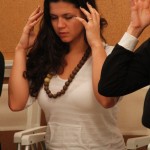
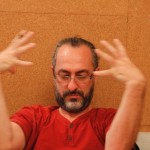
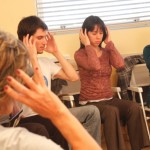
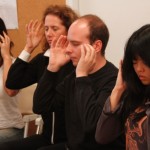
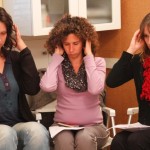
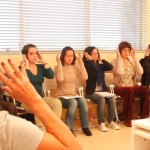
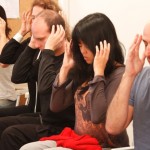
4. Regina: que palavras deste repertório novo podemos juntar com a experiência que acabamos de ter?
Forma, membrana, sensação, pulsação, presentificar-se, corpar, maternar, atenção, captar, relação, rede, percepção, presença, reverberação, corporificar, borda, pêndulo, conectar, apropriar, ambiente, vivo
5. Regina: Agora vamos desenhar esta experiência. Quero que vocês desenhem um contorno da sua forma geral excitada com o registro dentro da distribuição localizada das diferentes intensidades da excitação
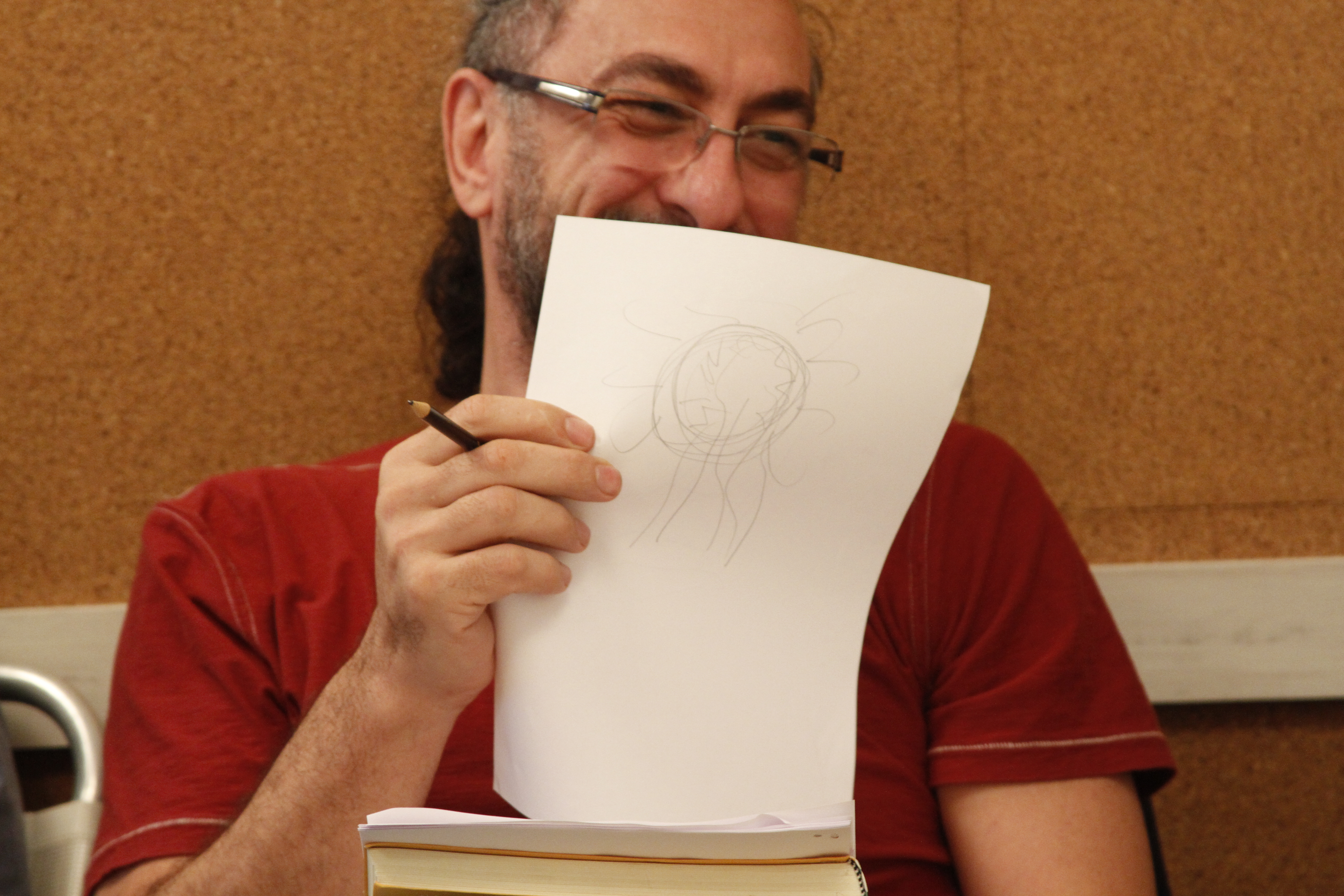
6. Quem sente a boca também excitada além do ouvido?
… compartilhar palavras…. repetir palavras…
captar a forma da experiência excitatória….
representar graficamente a experiência excitatória….
aprender é gerar películas de organização corporal
para fazer isso ou aquilo…
e repetir….
Ten embodied conversations
Following the protagonizations of a student throughout his formative education.
0. A dispositive
In the seminars at the Laboratório do Processo Formativo we study how bodies produce themselves and in the same act continually produce environments. Many actions compose the strategy through which we plunge into this evidence. In the room, there is a succession of me talking, conversations among and with the group, formative theory, and exercises taken from the event itself, be they individual or collective, contemplation and embodiments of images in the video recordings produced in and by the group, cartographic eggs, solos by participants, precise clinical interventions, participation of collaborators in molecular biology and anatomical exercises… a living process resulting in a production of embodied knowledge about what our constant focus is: how bodies produce themselves and their worlds.
Over 4 to 5 semesters of formative education the group learns the following:
1. A formative paradigm, where the model of the living extends itself from the molecular to the existential forms of human bodies, always following the same rules of connectivity and aggregation, deepening the vision and the body’s experience while an environmental processor always in the process of producing itself and environments, networking with other bodies.
2. An anatomic model that is able to proceed forming out of the lived, or how affects materialize themselves continually into somatic structures throughout a particular life according to the interaction of the embryogenic layers, in a continuous embryogenesis from the beginning to the end of that particular soma.
3. A vision of the body’s growth, from conception to old age, always supported by somatic bonds that can offer a reliable environment and a formative time, which are necessary for the subjective organism to keep developing modes of connection from fusion to cooperation.
4. An evidence that this process always happens inside social history and the interplay of powers and values. At this moment of the embodied learning, the students are already able to recognize, study, and act upon the modes according to which we make body in our worlds with social forces and bonds, and how these ones have molded and keep molding our somatic and connective reality, following the formative logic and grammar that have been studied over the previous three sections.
What we call eggs is a big egg-shaped board on the wall, where we draw diagrams of thought which organizes the formative process experience that unfolds throughout the encounters.
The eggs encompass the how, the when, the where, the conditions, the cycles, the rhythms, the principles with which bodies produce themselves, their relationship to language, social history, molecular biology and neuroscience, mapping what is being lived collectively.
As people assimilate this knowledge into their bodies, in their language and in their notebooks, it reveals itself, as a somatic reality, that these bodies immersed in the bodying field of each group in particular, inside larger and smaller environments, are pulsatory pumps that function as environmental processors “drinking and secreting environment.”
The groups, through this dispositif, have the opportunity of living in real time, the secreting and the molding of the body, the intervening in its shapes through specific practices, the maturing of them in the act of co-bodying with the present conditions, creating connections that keep increasing effectiveness in the production of self and cognition.
At the end of the program, the existential design of each body in its actions and expressions muscularly preserved by the memory of its repeated use, broadens its meanings. We contemplate, at this moment of the group, through the collection of photographs of each one, bodies in their bonding and social molds, their formative paths, their participation and modes in different environments, and the construction of their life story up to the present. Always enlightening the question of how this body, and with what forces and muscular combinations, sustains its present shape. And finally, we discover, inside the formative logic of each body, how to intervene upon this configuration, updating it a little more so that it gives way to the forces of the present, feeding its continuity with such forces. In this environment of images, images are gathered all the time, as video by the camera man present in the group and as photographs by the group itself who passes the camera around for everyone to use…
The images – whether they be recordings or photos, current or from each person’s life – are important to provide the evidence that living bodies are a whole set of actions, slowed-down actions, solidified as tissue and that they are always in action, molding actions… some kind of action… upon themselves and upon the environment… an anatomy of tubes inside of tubes such as Keleman describes in his Emotional Anatomy, pulsating, bringing to oneself, driving, processing, through an infinity of actions on multiple interconnected levels, shaping oneself and expressing oneself upon the environment, articulating oneself or drawing oneself away from other bodies, in almost infinite manners, always producing oneself and the environments, in some way.
This way of functioning in multiple layers of the event in the environment-seminar results in a constant recognition of the modes of functioning there-in-the-present and in a less and less narcissistic relationship, be it negative or positive, with one’s own images, which results in a naturalness that is captured inside of the evident artificiality of the presence of the devices of recording and exhibiting images… Capturing image, allowing one to be captured, watching oneself, recognizing oneself, exercising a formative grammar, practicing the act of bodying…
The different aspects of anatomic design of behaviors, actions and expressions become a language increasingly more prevailing in the groups under my baton.
Conducting the group process, for me, Regina, in its continuous flow of somatic presences and actions that sustain it, is, par excellence, the exercise of immediate and embodied contact with the living event that feeds me in the creation of language and formative knowledge. The living event, in its permanent morphogenesis and metamorphosis, requires a posturing of affects, a poetics and an orality, all specific to this communication.
A well-assembled collection of transcriptions, video recordings, photographs of a dispositif of production and capture are a treasure of registered events to which we may always resort, as we are going to do next. I believe that this is a great instrument, if not the instrument, for producing knowledge and its transmission to people who thinks and works upon embodied reality.
1. A body that thinks
Student– thinking is making me suffer…
Regina – Try to be a little more permeable… your design communicates to me that you have an evident fear of losing your thought if you get less dense… try getting a little less dense and see if you can think better… let your gaze get wet and not so focused. Organize in your eyes an expression of looking for … yes, blink wetter. Let yourself breathe a little more in the environment and you’re going to see that you will grasp better: bodies communicate what they are living and doing out of their design. Each one’s designs are understandable to others.
Regina – Look at me … see what I’m doing…
Student– It’s hard to understand…
Regina – Actions are their anatomical shape… look at me… I am giving you some time… look…this is my action…. I’m stopped… interested… in you… without pressuring you… that’s what I’m doing…
Student– I feel a strong intensity that comes from the belly as I am here… it’s hard to keep it and connect with people at the same time… then, I lose it… it is too much to manage.
Regina – Yes, you lose it because it’s too much for you… you don’t trust that you can shape and express intensity through your chest… as if you didn’t want it to go through your chest… making it go from the pelvis straight to your head.
Regina – So, let’s open up some more space in your chest, creating a field behind the breast bone… at this level that is more relational… You lack the experience of having a chest. The intensity of the belly is pre-personal, the chest is more relational, more personal… See if you can create more space in your chest, in order to grasp the environment and let the excitement fill you from behind the breast bone. Notice how your lungs fill, rotating inside… the heart talks to the lungs… give yourself a time to grasp their action of the in your chest.
Student– It feels much better, it gets cooler.
Regina- Excitation starts to be distributed throughout more areas. Try to grasp from behind your breast bone, your feeling of the esophagus, trachea, lung movement and see how you get a whole landscape of intensities within your chest.
Student– My eyes calmed down…
Regina – Now you’re feeling … before, you wanted only to see through your eyes … see how different it is to feel with your chest. You can keep a pulsation in your chest as you keep it a little inflated… your chest deflates very easily…
Student– Here is better, somewhat aggressive… I have a certain fear of coming into contact with my aggressiveness… but one needs aggression to grab the environment.
2. Grabbing the environment is an aggressive act
Regina- I have a fantasy: big bodies fear their own aggression. Look how you can fill your chest and become more powerful… with this feeling of being a lion, a king, a big man.
Student does it and laughs
Regina – To be able to be a handsome, big guy… a man who shines.
Student – It’s really hard, so many things happen and one starts to make distance…
Regina – You just described how a body takes a protective shape… life happens and bodies keep shaping, finding adaptations to situations that are sometimes overwhelming… this is what we call unbearable present… we have an extraordinary muscular adaptability, we keep molding ourselves in each condition… suddenly the defensive behavior that one day has been useful, is already stabilized itself muscularly and you no longer realize it… you just notice that your field of possibilities has narrowed.
3. Chest: more tame, less tame.
Student- I feel a stiffness in the front part, a lot of pressure.
Regina – Show it … let’s focus on it … if anyone in the group wants to imitate him, will understand what goes on with him … You can lie on you back and organize yourself the way you see in your image projected on the screen right now.
Student– I see myself looking for something…looking for a place in the space…a big rigidity…
Regina – So, you have an idea of what you were going through at that time.
Student– The difficulty of letting go and just be myself.
Regina – Do that again now… imitate what you see yourself doing…. the belly movement, the back and the shortening… do and undo the same action.
Student– I was trying to release my body, to let go, to lower my belly, to find a state of more flexibility.
Regina – Notice the relation of the three pouches … head, chest, and pelvis … what is this experience of you trying to coordinate the three pouches…
Student– It seems like there is something that prevents it…
Regina – Keep trying to grasp this place that prevents it and see what kind of experience you get from there.
Student does similar movements to those on the screen’s image…
Student– It seems like if I can stay in this place, if I slow down, I find more space… it stops being simply bothersome.
Regina – How do you use your back?
Student– The front gets collapsed… if I squeeze a little below it seems like it goes up.
Regina – Lie down again… as if you were a lying map of yourself … bend your knees and put your feet on the ground. How do you compare your belly and your chest?
Student– In this position my belly gives in, but in the thoracic diaphragm there is a strong pressure, it prevents communication between the pouches. And there’s a lot of pressure in the back. It makes me feel very uncomfortable … it tightens…
Regina –Remember what we talked previously about the big and tame you. See what is the difference between making firm the pelvis and letting the belly go.
Student– I don’t like to let the pelvis go… it seems too nice to me… it is like energy doesn’t get to my head… it makes me long for isolation and nothingness. As I close up the pelvis, I have my mind cleared up again.
Regina – Close your hands at the same time that you close your pelvis
Student– Then my chest rises and my throat opens.
Regina – You can organize in this position, a more affirmative shape of yourself… keep sliding yourself along the connective tissues… go from the affirmative to the tame shape and back… your feet?… what happens?… the feet look loose, useless … see how you can get affirmation also from your feet. Notice your hands. Organize more firmness in your hands and another degree of firmness in your feet. What about your throat?
Student– It opens up, it grows from within.
Regina – Make this statement: “In this position I affirm myself”.
Student– Here I affirm myself.
Regina – Is it good?
Student– Oh yeah!
Regina – Repeat it… press into your feet and go ahead… use your voice… let us increase the relationship between voluntary muscles and the cortex
Student– Here I affirm myself, here I affirm myself.
Regina – You just moved your pelvis and pulled in your belly. Keep saying here I affirm myself, here I affirm myself. Now let’s make an experience: let your pelvis go and get tame, intentionally. Say: here I become tame. A big man who doesn’t threaten. Does it make any sense for you to embody the big and tame? Experience yourself going from soft to firm. And vice-versa. A few times.
Student– I feel better, it gives me the feeling of going more into the world. This position is even comfortable and not too aggressive…
Regina –It seems like you are learning something about your own formative rules… you are fuller of yourself… it’s important to pay attention to that… when you let your belly go, your chest loses expression… the presence loses its integrity… the shape’s integrity.
Regina: Stand up again and try to find the relationship between the pelvis and the impulse from your feet for you to grow into your real size… see how you make the connection between pelvis, chest, head, through the throat, thoracic diaphragm, perineum and soles of your feet. It’s the accordion man that you can see in Emotional Anatomy book… in you… do a little more and then a little less of that shape… this is how you can regulate your intensity and learn how to sustain a higher degree of excitement. The time you turned off aggression, you must have been scared about this lack of control over your strength. I figure.
Regina: Identify how your body is right now… Let’s rehearse this: more tame, less tame, more tame, less tame… Do it with your eyes, too. You have very expressive eyes, quite integrated into your general shape. How do you feel about your vision when you build up more assertiveness?
Student– My vision changes a lot, it seems that peripheral vision expands and gives me a better feeling of space… I see more around.
4. Deepening the problematization
Regina – If you lie down again, maybe you can receive the pulses from deeper muscles. We are problematizing your taming, how you do it… its anatomy… and its meaning for you. Let’s repeat it with variations: more passive, more aggressive, more tame, more assertive. Now we’ll wait a little and pay attention to the motility in the deep muscles. Rest and let your depth express itself. Is your depth contracted?
Student– A lot.
Regina – So, you’re going to contract your depth more than it already is. Intensify what already is. Keep it for a while. And now you just undo step by step the contraction of the depth. Go down by degrees. And make a stop each time. Rest now. Stretch your legs. Just wait … whatever happens. You stimulated the pattern by intensifying it. Now it is responding by swelling in the opposite way.
Student– There are two events in there at the same time… my spine is sparking inside, deep inside….
Regina – That’s it… put your feet on the floor and you are going to receive this excitement going up your spine… what is happening in the deep muscles?
Student– It’s ok…
Regina – See if you can now let this excitement go further into your chest… that’s it, now you’ve got it, using your feet and using your pelvis. That’s it.
Student– It seems like there is someone sitting on my chest.
Regina – Who is that you that is seated on top of your chest?
Student– Myself.
Regina – Who is that you? What is the story of sitting about? A fear of change, an old accommodation?…I wonder.
Student– I feel a split between the left and right sides of the spine… a difference in tone… the right side is tenser, I am more supported by the right side.
Regina – Perhaps it means an impulse to turn over, avoid the contact that maybe is invasive for you right now… I see an outline of twisting in your general shape. What happens if you do the movement and deviate from the confrontation? (Regina helps the twisting in the floor)
Student– It’s good… it’s like running away. I need it… but like you did is too much.
Regina – Maybe it will be enough if you just turn your face and change the focus of your eyes. How do you feel?
Student – A lot better.
Regina – So, don’t look forward, don’t put your face forward. Only a slight movement to the side. See if it creates a feeling of privacy for you.
Student– Better.
Regina – That’s it. See what happened with the tone of the two sides.
Student– Now there is more balance. I feel more support in the lumbar area, my hips are firmer.
Regina – See how this movement of firming the hips gives you a center which is yours. You can also carry this feeling of privacy to your hips.
Student– There is a feeling of confrontation, down in the hips. It gives me power. It provides strength.
Regina – Is that good for you?
Student– It’s great.
Regina – You can keep practicing this form when you go home, first for yourself. Then you will see the effects on your relationships. But you need to practice it. I think there is another thing that we can observe from evolutionary theory, animals have all basic actions in common – turning, contracting, firming, rising, descending, closing, twisting… but there is a Who… and that changes everything.
5. Bodies understand each other
Student stands…
Student– Anger… I felt like I was losing my balance in the posturing of presence…too tense to stand on my feet.
Regina – How? What’s quality of the experience? What’s its pattern?… Show me and tell me… Keep saying and doing it… Make your pattern and say at the same time: that’s what I’m talking about… that’s what I’m talking about… don’t rush… you just described it but what is the existential condition?
Student– Feeling angry in the pouches. When I do the pattern I can feel a big pressure on the belly, pulling down, like it is about to turn into something crazy, too strong. It seems to me like the way to the legs was blocked. But as I manage to open it, the ribs go down, the throat opens, even my voice changes. And it looks like I see the world differently. I get more excited. Thoughts can flow better.
Regina – That’s it, thought is meant to go back and forth into the world. As you unblock the way down to the legs, you de-isolate yourself.
Student – I can already grasp a lot from outside. But I have trouble working with myself, feeling myself, grasping my inside. But as I stay here with your help it seems better.
Regina – To be more present and in contact…this is better… we’re in no hurry
Student– I feel damn hot…
Regina – You’re expressing yourself.
Student– That which was stuck starts to flow.
Regina – One thing is to grasp outside (exteroception), another thing is grasping inside (interoception). And there is a third function which is grasping one’s form itsel, how do I respond to all of this… and it is the proprioception. You are good at grasping outside and feel excitement rise inside, but for some reason, you don’t identify the nature of this excitement as experience… what am I living? I don’t know, I’m just feeling strange…
Student– There is a lot of fear that comes in the contact, I have always been very afraid…
Regina – That’s the first time I’ve heard you say that… “I live excitement with a lot of fear”.
Student– Fear of not being able to control… that’s why I hold in too much
Regina –You can grasp by proprioception how you control… let’s isolate this experience (he does the gesture of containing)… then you can say: ‘that’s how I try to control excitement facing a world that causes me fear and excitement.’
Student– It hurts… it seems like an impulse to stretch and the body doesn’t want to…
Regina – This is what direct experience is all about… the body doesn’t want to… this is what I live right now…then I can understand that I’ve learned in my upbringing that excitement is not a good thing, that we shouldn’t trust excitement, it leads us to things that aren’t good…
Student– I was a rebel but an isolated rebel… I protested by remaining stuck. (He does the gesture)
Regina – Stuck, revolted, but guilty and afraid to express yourself. To express yourself is, in this case, letting your legs grow, your chest open and presenting yourself… but you can’t… because there is fear of expressing yourself,… this would make you feel guilty… it will make me vulnerable to the world… then I’m going to be very anguished… with my head full of thoughts… this is guilty…feeling alone in the world, feeling excluded, asking yourself what it was that I did…thinking, thinking, thinking…reviewing the scenes inside your head… you are telling a story that I can imagine because you are showing me how you live it with your body… bodies are made to be intelligible, bodies are no mystery, all parts of nature understand each other… nature is intelligible.
Student– It seems like everything is getting lighter.
Regina – You just did a performance of yourself in the present… producing experience for yourself… I’m very happy for you… notice that when languaging and doing at the same time one can find out that there is continuity between body and language, verbs and actions.
6. Talking about he maturational continuum of somatic forms
Student– I’m thinner than I used to be, I used to be thicker. I get the impression that if I had more muscle I could hold myself up better.
Regina – Is that a question? How old are you?
Student – 52.
Regina – Now is the time that you’ll start gradually lose muscle mass… there will be a time that you will have a great loss… you’re entering a mature stage (fetus, baby, childhood, adulthood, maturity, old age). An adolescent is an unripe adult, followed by the alpha adult… then the alpha adult maturates … then comes a stage that is of de-hormonization, the decrease in hormones that leads you to this loss, the reduction of muscle layers and a change in shape. Keleman deals with this a lot… in the mature adult, there is an increase of sensibility with the increase in muscle porousness and the increase in the belly pouch and the reduction of the young adult’s big chest… with this, muscular layers get thinner… then levels of resonance regarding the lived can become incredibly more profound… power gets different at this phase, it’s not the physical power to go fight and win… the strength for procreation and all the things of youth … but you enter more levels of ability to capture, absorb, digest, assimilate events… you’re entering this phase. You’re in a full transition.
Student – And what about the maturity of the chest?
Regina – You have to update this chest that belongs to your former story, it a preserved response of the unbearable present of another time, in order to form a more whole, deeper, mature adult who is able to give support to thinner layers… this is from the biological maturational program, this body is presenting itself now, one body shape follows one another along life… as is now visible to us … When did this chest expression has been formed?
Student – Adolescence.
Regina – This point already has to do with hormones, the acceleration of the body’s growth… that is where we find this unbearable present where he formed that full, dense chest. , which cannot be emptied, preventing you go down both legs, firming and affirming as we did before…
7. An experiment belly down with the subjective anatomy
Regina – Now, please, lie on your stomach and feel legs, chest, pelvis… but stay still resting on the floor…and capture your own shape, feel borders, the volume and weight, just breathing the environment in this lying down position… you’re going to grasp the relationship of this chest with the belly pouch and the head pouch… the relationship of this chest with your arms and legs … it’s an anatomy that puts you back onto what your pattern does for you to live.
Student is lying down on his belly.
Regina – open your arms a little more in order to check this relationship: arms-chest and chest-pelvis. There is a small lumbar movement… tell me what you are living, experiencing, understanding.
Student– It seems like my body is more adapted to the floor, at first my pelvis was really high, it seems like it softened a little more, at first I had a lot of pain in my shoulder, it was impossible to lie my right arm on the floor. There was pain in the deltoid, now it’s better.
Regina – See that you are learning how to give yourself a more mature time to capture your on going process.
Student– My diaphragm is more permeable.
Regina – The diaphragm is more permeable, the pelvis can talk to the chest pouch… it is not shrunken, scared and angry all at the same time as it used to be… you are more calm, with a calmer presence, your shape resting on the floor.
Student – A calmness.
Roberta – How could you show me the adolescent angry pelvis?
Regina – Shrunken and charged.
Regina – Excited, full of energy, but without an allowed expression… can you show us the raised pelvis. What would this adolescent with a raised pelvis be like? What can he do with all of his excitement…
Student– Do a retracted pelvis…
Regina – It ended up retracting… whoever wants to, in the group, lie down and imitate this… imitating serves to understanding… make his pelvis… please do it so everybody can see… look you guys where he pulls his pelvis away from the floor, where contraction is… the pulse stops as you shape the pelvis like this… it reduces the expanding and contracting actions of the living pulse… it’s still the response of his form to excitement… his form still doesn’t know fully how to do otherwise… as it didn’t know, at the time, what to do with adolescent excitement… a big boy who didn’t know what to do with all the excitement… his familial environment was guilt-inflicting, moralist and the boy became revolted… didn’t dare do it any other way… look at how there is a shortening in the lumbar sacrum and tightening in the gluteus and with this the iliac rises from the floor… this is what memory is all about…. a structurally stabilized response… in his case, still tightening… this is the anatomy that you can identify, formulate and show after having this long formative time in this group… nowadays, you are able to lie on the floor and do this performance… Keleman calls it biodramatizing… now you can… the form already has an understanding of what it could do… what is the point of knowing all of these things?
8. An experiment standing up with subjective anatomy
Regina – Think about this pulsatory anatomical language… how do you apply it without failing to be personal… an embodied language… we don’t stop being ourselves in order to use this anatomical language…
Student– This is the hardest area, the diaphragm. Since the last time we worked, it got much better, I am able to roll in my body better… my chest was too rigid to bend down, I felt like there were so many things holding me…
Regina – Things holding you… hmmm, you have already much more language than that… think a little about the shortening, about its relationship with intensity…. you have increased the degrees of expansion and flexibility in the shortening pattern and ,also, the degrees of filling and emptying the pouches. So the excitement doesn’t stay anymore that stuck and protected by shortened and hard muscles, an excitement that, before, only could go out like a blast from a cannon or stays inside ending up depressing you.
Student– I noticed that the issue of the inferior members is much different… here it got a lot better…
Regina (to the group) – So, we are going to do it together with him. We are going to grasp this way out of pressure/excitement from his pelvic pouch. Instead of letting it go up and getting stuck in the chest, we are going to send it back to the pelvis… how can the excitement go down to the legs instead of rising to the chest? You are going to notice the three pouches… how to find possibilities of going down from the chest to the belly.
Student– Contracting the gluteus and the oblique muscles and also moving my weight towards the front… moving my center of gravity towards the front… it gives me the feeling of flowing more.
Regina – And what is it like, this flowing experience? It’s not just a mechanical experience… making this passing through the groin and sliding the intensity down the legs. This has to do with your pelvis… you begin to have an accordion experience in the thighs, in the calfs, on the soles of your feet, in the gluteus, in the oblique muscles. And there you begin to promote the contracting back of the pouches.
Student– My feet feel like opening and the same happens with my hands.
Regina –Do it with your hands… like this you organize a different expression of yourself in the environment… notice that you can place your legs…. but you keep retracting at your chin and throat. There is a whole mobilization of your high back and your face in the sustaining of this retraction. There is confrontation in your gaze and muzzle which has to do with a long history of retained anger. A confrontation that is not meant to be visible. Coming forward on the balls of your feet allows you to come forward with your face as well. That’s it… you are going to use a little of this pelvic dislocation you just learned… so you can let go your belly pressure down through the groin.
Student– Now I realized the internal connection between mouth roof and pelvic floor.
Regina – So, you are going to organize your inner hollow. You say that you have little internal resonance towards the events. Now you can assemble your mouth, the diaphragm at the roof of your mouth, the sphenoid diaphragm, the whole larynx, the chest, the pumping of the entrance of the bronchi right above the heart. The thoracic diaphragm, the belly…
Regina – Now you are going to find the connection between throat and face… do it now. That’s it… try to grasp it… in your face, in your cheeks and your jaw muscles… can you feel the effort for tightening? the density of it? there is a lot of anger, in the mouth, in the teeth, in the eyes.
Student– The space in my mouth just got a lot bigger…
Regina – Brest bone… all of this is stretching right now… can you realize how you are stretching?
Student– Everything comes from below, it seems like everything up here has just relaxed. It even seems like my jaw got lighter, also my skull. Wow! It feels like I grew, even my head expanded…
Regina – Do you realize the state of density in which you live? And how it is organized? And what its meaning is?
Student– This gives me a lot of inner strength (he sways on his firm feet). Here I really can. My head is opening, my skull cap too.
9. HERE: the somatic subject
Regina – HERE I am responsible for what I do, HERE me my self… keep looking for your HERE, the HERE, an inside of voice, of vibration, of presence…
Student– HERE I affirm myself.
Regina – HERE I think for myself. … your legs are going down… HERE I am going to look for what I need…
Student– I feel that it no longer requires so much energy to keep myself up, it seems that everything fits better.
Regina – Certainly… that is a possible organization, it’s going back and forth between the previous shape and this… (look at the TV monitor). Look at the difference in density… that arm, that back, how the density shortens them and doesn’t allow you to go down… how the chest remains full…
Student– As my shoulders drop I feel mobilized emotionally.
Regina – I want you to experience this dimension… it’s not easy. Your shoulders go down as you find the way to de-densify, allowing for elongating.
10. Outlining a formative task.
Regina – Do you want to talk about your shoulder’s problematic experience? or would you rather stop here?
Student– It’s too difficult for me to disorganize the density of my shoulders. I went back to the last experience and I had the feeling of strength again… but it seems that at a certain level I get lost.
Regina – Power is the question. To find a proper place for your shoulders has to do with power, because real power has to do with being able to express oneself fully in the world. The shoulder girdle is extremely expressive. Shoulders and arms have to do with exchanging, talking, showing… all of these actions, we shape them mostly with the shoulder girdle: clavicle, shoulder blades, arms, articulations, hands… There’s a whole world inside of the thorax. A lot of the experience of oneself and the reality of one’s experience in the exchange with the environment happens in the thorax. Inside the thorax is what I am living and how I am living the environment. There is a whole relationship between the shoulder girdle and rib cage. Power is made up of an incredible regulation of actions, in order to be in accord with the truth of what you live. But in you, there is a lot of density packing it together, preventing distinctions between different actions.
Student– yeah…
Regina – there’s something that’s very interesting about the direction of forces in the rib cage in relation to the shoulder girdle. Many people think that inhaling means just filling the chest. They don’t make the distinction between the inner layer and the external layer, just as we also don’t see that there are different forces between what the rib cage does and what the shoulder girdle does. In general, people think that all is the same structure functioning together.
Let me show you, I’m going to touch your breast bone. See how your rib cage is placed under a big muscle mass and how it immobilizes the breast bone, attaching the shoulder blade, pulling the throat and pushing up the upper back. You can see that there’s no way to make a distinction between the elements to allow a variety of self expressions when excitement fills your thorax. This requires distinctions to be made, otherwise there will be a feeling of imprisonment and limited actions. You will not get full satisfaction with your expressions. It gets difficult for you to have your own expressions. There is not much choice and the chest is the place that is full of choices. Here, relationships with the environment are made because precisely man’s encephalization and bipedization allowed us to free our arms, so that we could not only gather but do millions of things, relationships, instrumentalizations, uses… all of this comes out of the arms in resonance with the thorax and the brain. Period.
All of our shapes are connective, relational and are sustained by a whole set of deep pressures preserved by the shape of the pouches, tubes, diaphragms, muscle organization, a certain tone of muscle. This results in a certain pattern that is each one’s pumping pattern of the world which generates a who, who acts like this, who dreams like this, who relates like this, who does this and that likes this…hopefully in continual metamorphosis…this is what we are studying about.
Regina Favre
São Paulo, July, 18, 2012
Presence

In order to go deeper into the organization of presence it is necessary to go further into its place in the plan of the event.
Event is the state of things in their becomings, environments inside of environments, in which the body also in its state of becoming, is immersed as part of the event itself, by the simple act of existing. Event is that which is contemporary to a body’s actions through which its continuity is molded.
Event is the outside, the inside and the outside of the outside of any body, in its interaction and simultaneity. The event is made of simultaneities, powers, values, images, language in many layers that are physical, affective, social, anthropological, cultural, historical, technological, political… The event can also be called bodying-field, an expression I picked from Stanley Keleman, author of Emotional Anatomy. Bodying field is where bodies meet in their co-bodying activity.
Each body is a place, a here, in the event.
In order to begin, organize this place. As you read this text try to organize an outside for yourself. That’s all. What happens when you organize an outside?
The inside, the outside, the outside of the outside… how do your outside absorbs the outside of the outside? How your outside absorbs and transports the effect of the outside of the outside to the inside?
Your outside outlines a design that is a response to this affection creating at the same time an expression in the outside of the outside. In other words, the outside organizes a certain design that is an alteration in the membrane between the inside and the outside of the outside. This is behaviour. We are talking about a particularized anatomy, a living design, which in itself is a configuration between the inside and the outside of the outside, a configuration of the outside that organizes body parts in a certain way.
I can, as I edit this text, do an experiment, for instance, with my outside.
I want, to fine tune my ear in order to better capture this noise that comes to me and better grasp which melody it is that a hammer is producing, right now, on the floor above. I will organize all my shape in this keen way of listening to. And then disorganize.
The noise stopped.
Then started again.
What do I do with the outside of my head in order to change what is going on inside? How do I shape listening or how do I shape all myself in order to listen? What is just happening is a modeling of oneself that we can recognize as very ancient in the evolutionary processes… I´m talking about this way of isolating the inside in relation to the outside of the outside… If you touch a worm you will see how it thickens to protect itself. This shrinking and the extending back occur independently of one´s participation. It is a reflex which alters the shape of the body. But I can use my cortical animal condition to exert some action upon this.
The hammer stopped. What did I do? Perhaps the here is somewhat rigid and readying itself for the next hammering. But I will again, intentionally, fine tune my walls and expose myself to the startle of the next hammering. I want to see what it’s like. This teaches me. I want to see what it’s like. How did I respond to the hammering? What response did I give to the hammering? How is this ancient response just triggered here?
What is the shape of my outside like right now? What has been contracted in me with these three hammerings that just broke in? May be I´m feeling an increase of accumulated excitation of and perhaps I feel in my arms and legs impulses to shake it off. I can make strong movements with my arms. But I also can keep it in me and capture the design of this response.
The outside is not only what is visible. Outsides are all the walls that encompass the passageways that maintain the pulse in its function of driving the outside of the outside to the inside and the inside to outside of the outside of the bodies, in their work of pumping and processing the environment. Until the end of the day I will go through long moments without hearing the hammer´s sound. Later I will notice some stressed structures for being long immobilized in order to block noise from invading my brain. (See “Pulsatory Pump” in Stanley Keleman´s “Emotional Anatomy”)
I can come back to the previous experience and notice how this here is not only pulsating but also inhabited by words, images, the day, impulses for connection between people, between bodies, between topics… This here is always inhabited.
Before making any statement from this configuration that I am grasping right now, I can draw a somagram (See “Somagram” in Stanley Keleman´s “Embodying Experience”) as an exercise. Somagram is a graphic expression of the interplay of pressures and consistencies that we recognize on the surface and inside the body. It is a cartography of the present state of excitement. I can do either two operations at the moment: one is simply sharing with somebody what it is like and the other is problematizing.
I am going to give what I´m doing a name: Bodying Practice or the Practice of Embodying the Experience. This is the practice developed by Keleman that accompanies his emotional anatomy view. This Bodying Practice has a protocol that begins with capturing one´s immediate form. As one slows down one´s action, one inhibits the continuous triggering of forms. Then you repeat intentionally the selected form … then you note it , posture intentionally it and draw it… somehow you are stopping the flow for a moment… instead of dealing with the flow of consciousness, you deal with the flow of behavioural forms.
I just put a border in the flow of forms, a border on what is happening. How did I do what I did? What event is this inside of this border? What I want to bring back here and show myself? As I put on a border, I can begin to act upon this form.
The destiny of bodies is to proceed. They are born to always trigger new forms in their growth and actions, but also are born with equipment to shape a relationship to what has been lived with its inside and its outside in relationship to the outside of the outside, always trying to stabilize , aggregate repertoires and make tissue along its maturational journey. We are able to transform the lived into experience instead of letting the lived just to slip away or traumatize us. Our human genetic inheritance allows us to create loops of what has been lived over itself and solidify responses as body or muscular form, what is precious for our adaptation. This is not a luxury, it is an adaptive fineness. The more I refine the expression of my forms, bodies or behaviours, the more finely I connect myself to the present and to the event. There are some that happen without my knowledge and some that happen with my participation. Trauma occurs without my knowledge and learning, with my participation. This is the difference. Trauma is installed out of a reflex of the brainstem. Learning is installed out of a cortical-neuromotor operation on the lived.
When we inhabit each anatomy of presence, we have contact with the pulse that fills this shape. The pulse is not only a mental statement. The pulse is the digital rhythm of the present as grasped in the operation of making oneself present inside borders. We are always problematizing how to build borders, how to move from one outside to another, how to stabilize borders, how to give support to borders.
Problematizing allows for finding a finer adaptation for the structure that we grasp in the present. We are able of self-narrating “I am the one who…”… But the functionality lies in reediting oneself, always in a clearer manner, checking the meeting of one’s body with the present conditions… it’s not exactly that… attention…
The clinic is this, working together to update somatic form, self-narrative and bonding modes, making one´s self present and promoting presence in the bodying field, together with your patient.
Example of a formative updating with a student:
Student: Organizing an outside created for me a sensation of wellbeing, of feeling great. As I organize the inside, it seems like spaces arise for exchanging, creating holes for the entering and exiting to happen. When you said to think about the outside of the outside, I got a sensation of too much, of oppression, my whole body got small and contracted, losing all of the wellbeing, my jaw got stiff, like wanting to bite. It has been hard to get away from this feeling.
Regina: There are many forms of the attack reflex… several structures preserved by evolution through which the animals operate the attack. The jaw is powerful, the masseter is the organism’s strongest muscle, the bite has the strength to immobilize the source of danger. The jaw is an ancestor of the hand. Before the hand there was the jaw. Among fish, when the jaw emerged for holding prey it made the fishs with jaws into the big powerful guys in the oceans. Before this articulation emerged, fish only where able to suck in their surroundings and directly swallow … they didn’t have a biting structure.
Student: now, as I speak and act at the same time, it gives me a very strong sensation of presence.
Regina: When we inhabit ourselves as form, as anatomy, the layers present themselves not only the historical but also the behavioral ones. If you want, you can extend the presence of the jaw to the hands and feet, to the extremities of excitation,
Student: it seems like energy comes to the surface.
Regina: it got more intense, it spread out
Student: It brings an enormous well being.
Regina: This is updating of one´s self, power increase, a possibility of using yourself in a more extensive way. The more you use yourself, the more you identify with the unique logic of your functioning.
The invention of the cell membrane, as says Keleman, is everything.
Membrane as a pulse regulator, a relative separation, the borders of the pulse that pumps the event-environment in and out, in a continuous action in which the event is squeezed, processed, absorbed made body and projected into the environment as a response, from micro to macro, in a concert of parts that produce a bigger processing.
The body wall follows the model of the cell membrane.
We can grasp different states of wall: distant, close, mixed, dense, threatened, invasive. The state of wall gives us back the sense of body image. Then, I can apprehend how I do what I do… how do I make presence? Backing away, with fear, invading, mixing… how do I do… what am I doing right now? In this picture I can identify lots of excitatory activity here , little there… it is a motile geography of excitation or events of intensification and de-intensification, all over the whole body, molding a set of connective shapes to the environments I´m part of. This grasping of body image allows for such an instantaneous mapping. All the time we can grasp what we are doing and how. This is how bodies recognize themselves and then regulate themselves through all the actions they perform all the time for being in the world.
But, we can do this more finely, intentionally. It is from this configuration of the intensities in us that we can know what we are living. It is from inside of my form that I can have the experience of being who I am, of doing what I do and how I do it.
Several pulses coexist in an excitatory pulsating concert. Every cell, every tube transmits in waves, every organ and tissue, every shape in a set of several frequencies at the same time, play the silent music of the event in each organism, like a Zen evidence… a direct experience.
I can call myself again to organize an outside. How is it organize an outside?
How does one organize an outside? What do you do to organize an outside? That is an important know-how because slowing down is necessary to organize an outside, it is a delimitation of a here, the where where I am processing the event as a pulsatory pump.
My state of organization contemporary to this event is a here, immersed and processing the event of which I am producer and participant, in the larger formative process.
Organize again an outside. Capturing the form we are making is not simple, but it’s all one needs to be present and is all one needs to give singularity to each presence. Again,directly capturing what we do and how we do it is all we need to be present. To capture is different from observing, being conscious or being aware.
You can capture, in the 1st step of the Bodying Practice, your membrane, this configuration between the inside and the outside of the outside. This shape is always about the moment but this response is what my present form can give to the environment. It is its historical construction that makes it so that a body grasps itself and the event and responds according to its shape. And the alteration upon this (the self) is slow and happens in the biological time no matter event happens in world time. The form grasps, responds and organizes a response at the same time. It’s not easy to just think about this because it is profoundly anatomic: thinking-bodying.
Make an outside. Make your outside. It is not a feeling but a grasping of a concrete shape. And when we turn the outside a little more muscularly distinct adding an increase of tonus in this shape so it gets a little more distinct as a mental design as well.
This is what Stanley Keleman teaches for giving start to any process of embodiment. Then the brain grasps the form. This is what we call proprioception. It does a grasping or a capture not just mechanical but the grasping of a sense because the form in itself has an intelligence, the intelligence of its functioning. What form is this? It is a form that has a sense. It is the shaping of my presence, the form through which I make myself present. It contains my being alive, my pulsation and regulates how much and how I am connected to the event.
Then, outside is not just appearance. Outside is the containment that keeps the walls that sustain the pulses in a certain way. The symphony of pulses in me transmits to me what I am living, the quality of my experience in connection to different fluxes in the present, this is how event is in me.
In this pulse of my thorax, for example, where the walls are organized in a certain way, the event of the outside of the outside is interpreted in a pulsatory and digital language. I can not only organize, but I can also disorganize the configuration of my outside. Step by step. This is part of Keleman´s How Metodology. Then act on your experience.
When you make updates on your form, you enhance the proceeding of your journey towards the future. In the design of doing the same, you introduce difference and continuity. One’s form also gives form to the outside of the outside: it cuts it and interprets it. Elaborating the question of presence allows us to manage our connection and belongingness to the different event-ecologies in the collective production. This is to be alive as any living being…to be a living element of the environment.
Slowing down of the continuous flow of forms teaches the muscles, the nervous system and the excitation. To be present is a question of tuning the muscles and nervous system together thereby working to updating and realizing the form of our presence. This way we begin to conceive ourselves as an unique anatomy with its unique rules of aggregation and connection. We need to learn from experience what are the rules from which our body is produced and the practices that allow us to capture and influence this reality. This way I can work continually on updating form, connections and self-narrative, regarding presence configuration inside event.
A body in the multitude: from the molecular to the lived

*The word used here in Portuguese, muvuca, an indigenous word meaning the mixture of several grains and seeds with dirt, in order to reforest a devastated area, is also used in common language to mean an unorganized group of people making a mess. (www.dicionarioinformal.com.br/muvuca/)
TODAY’s Bodies’ Formative conditions: a cartography
Bodies-Individuals: relative, interdependent, and interconnected, forming unstable layers of social tissue, where the capacity for maintaining aggregation of oneself and connection with functional networks, in each body, plays the leading role.
Form of profit: it is more in use than in production; the benefits are more connected to circulation than to accumulation
Market-environment: it produces, above all, services, life-styles, and ways of insertion
Capitalism Today: It threatens us with exclusion, owing to its functioning in network, different from Industrial Capitalism that directly captured bodies through work that served the dominant classes
World power: on the one hand, financial and multinational aristocracy, on the other, collaborative networks and free production, above all, the multitude.
Dangers: loss of connections and false aggregation of the self.
TODAY anywhere on the planet the problem is in fear of exclusion.
Exclusion from physical networks is death.
Exclusion from social networks is misery.
Exclusion from meaningful networks is madness.
In this completely mediatized market-environment, in which we live today, we are always exposed to information that manipulates and horrifies us with situations of exclusion: sickness, aging, isolation, violence, misery, unemployment, abandonment, slums, hospital lines, etc, etc, etc, etc, etc.

In this state of terror that reaches everyone, we are taken by the experience of the somatic disaggregation triggered by the brainstem’s reflex response. With the startle reflex, the somatic process immobilizes and suspends its continuity as a way to block excessive excitation, fatal to the cerebral cortex.

However, at the same time, this same media that frightens us, apparently comes to save us… offering marketable existential contours that promise form, contention for excitation and inclusion. They are easily assimilated images that evoke the imitation reflex. Evidently, a formative jerry-rigging that lasts for a blink of the eyes…
A way of conceiving the body considering TODAY’s formative problems.
The body is an environmental processor in continuous production of itself and the world through the interaction of its embryogenic layers.
The body is a continuous autopoietic morphogenic process from micro to macro, from birth to death.
Urgent tasks for each body TODAY:
To place oneself in the speed and violence of collective processes and to cultivate a power that allows for maintaining:
- an aggregation of the self in continuous mutation,
- links of cooperation with different environments,
- capacity to assimilate the event, transforming affectations into tissue, neural, and muscularly structured, as experience and behavior.
And Never Forget:
- form, function, and behavior are the same thing, from micro to macro.
- work on the formative and maturing processes of bodies and their modes-forms of aggregation and connection require cartographies and precise practices, always observing the model of the living, which is:
- excitation, membrane, and pulse,
- continuity of embryogenesis from conception to death
- pulsatory pump
- canal body
- peristalsis propulsion within space
- connective expression


Each body
is a place in the biosphere
is a HERE
a self place traversed by hollows
genetic polarization
Myself

What to considering in the weaving of a self?
Aggregation of parts / Quality of membrane / Permeability between the layers/ Expansion-contraction / Self-recognition / Self-agency / Modes of connection / Modes of subjectivation /Directing substances and information of every type / Pumping / Processing and generating environments / Internal and external / Always in connection…
Soma’s Growth and maturation:

The maturational continuum of modes of connection to the environments: fusion, dependency, search for recognition, control, cooperation.
For pulses and connection surfaces to mature trustworthy environments and formative times are required.
Connection, in its adult condition, occurs through the cooperation of bodies.
Cooperating means:
- recognizing oneself only as part of major processes;
- acting as part;
- immature forms connect to the bodying fields merging, depending, seeking recognition, dominating;
- in the present configuration of our visibly networked lives, more than ever it urges cooperation.
A mode of being in the bodying field: the clinic realigns the formative process

Normapathy is the name of the forces of the mainstream. We are all, in one way or another, affected by the seduction of this apparently stable world. All bodies and forms, as they trigger, already emerge from the formative ocean directly in a capitalist world governed by powers and values that capture them inside of networks of meaning, molding them and modeling them. That is homogenesis.
Furthermore it is vital that we access:
- the startle reflex
- the helping-shapes created by the market for enveloping our anguish
- the paralysation of the connection form maturation process

How do you function?
A biological HERE traversed by hollows, self-referent, self-agent, self-regulated that keeps constituting SUBJECT by co-bodying in bodying fields through modes of subjectivation that are the social modes of constituting a SUBJECT and that has the biological inheritance for interfering in its own forms and to handle with them, immersed in the collective present.
Connective maturity and difference can only be produced on each body, each process, each connection, in a patient and crafted way, always observing the rules of biological formation where the body and its brain, problematizing each way of functioning, act together on “what is” and “how it works,” and carry out experiments on the intensities and amplitudes of each form, thus liberating the autopoetic forces in the way of condensing new forms to be grasped, defined on its edges, muscularized, practiced, cared for, and articulated to the environments, internal and external.
A politics of the living
Biology as it is understood today helps us to contemplate that the morphogenic organization of the living is molecular and in continual self-production, and that the multitude of bodies and the living operate in the same way, that is, formatively, autopoetically.
This is an extremely optimist vision
The continual production of bodies can be seen through a continuum of pulse producing machines:
- cosmic pulse
- living pulse
- genetic pulse
- embriological pulse
- membrane and pulse
- intensities and bonds
- the triggering of growth pulses
- the assimilable or excessive environments
- self-production
- difference production
- formative waves
- affects
- neuromotor forces…
Natural selection operates, always, from the molecular to macro behavior, in almost infinite combinational possibilities what de-absolutizes functions and makes relative the fitting of a flow with another.
A formative grammar needs to be deeply anchored in molecular biology, in the biological rules of producing tissues and forms, of the maturation of the bodies and their connections. This can generate cooperative practices of co-bodying production.
References
KELEMAN, S. Anatomia emocional. São
Saulo: Summus, 2002. [ Links ]
______. Corporificando a experiência: construindo uma vida pessoal. São Paulo: Summus, 1995. [ Links ]
FAVRE, R. Viver, pensar e trabalhar o corpo num processo de existencialização contínua. Revista Reichiana, n.13, p.78-84, 2004. [ Links ]
______. Trabalhando pela biodiversidade subjetiva. Cadernos de Subjetividade, p.108-23, 2010. [ Links ]
Seminário de Biodiversidade Subjetiva
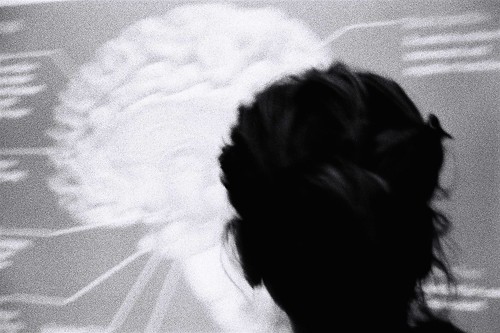
“Entre 85 e 92, a questão de uma nova posição na clínica, no ensino e na vida coloca-se para mim. Após ler o recém-publicado nos Estados Unidos ”Emotional Anatomy” precisamente em 86, re-descubro seu autor Stanley Keleman e me aproximo de seu conceito de processo formativo. Essa leitura funcionou para mim como um satori. Com ele, pude, finalmente, acessar um conceito visual e encarnável do corpo como um processo que se estendia desde os inícios da biosfera deste planeta, produtor e produzido por processos físicos e sociais, canalizando e secretando a si mesmo como uma força protoplasmática, continuamente, através das forças biológicas presentes em cada vida em particular, gerando e sustentando ambientes físicos e sociais como resposta a uma necessidade inata conectiva e formativa. Todo o meu movimento em direção a Keleman, um verdadeiro pensador contemplativo ocidental de tradição pragmatista e darwinista, americano, gestado na cultura do corpo novaiorquina dos anos 50, alternativa também para as visões budistas que se difundiam, veio, certamente, da insatisfação com a visão caráctero-analítica, mas, principalmente, da minha dificuldade em encontrar uma operatividade corporal precisa nas concepções que visitei de metaestabilidade em Simondon, de corpo sem órgãos em Deleuze, bem como de autopoiese e inação em Francisco Varella, idéias que me iluminaram e contribuíram para meu afastamento das cartografias reichianas.
Foi muito feliz a minha escolha por Keleman. Em seguida, comecei a cuidar da tradução de seus livros, a me corresponder com ele e, finalmente, em 1992, a freqüentar seus workshops em Berkeley, Califórnia. Esse contato seguido que durou 15 anos, foi um tempo suficiente para devorá-lo, digeri-lo e assimilá-lo… antropofagicamente, brasileiramente. Naquele exato momento, sonhei com a perda de uma criança na multidão e, logo a seguir, com a concepção de um corpo velho personificado por Kazuo Ono, que aparece deitado numa posição fetal dentro de uma banheira cheia de barro.
A ilusão infantil da individualidade estava indo embora dando lugar a um corpo recentemente concebido para formar maturidade, feito de multiplicidades e devires. Enfim podia me identificar com um modelo de clinicar, pesquisar e ensinar, bem como com uma filosofia do corpo que me permitia pensar e agir como parte de realidades maiores.”( em “Trabalhando pela Biodiversidade Subjetiva” Regina Favre, 2010, veja o texto integral)
Anatomia Emocional (link para o Google Books) é o livro de fundo no Seminário de Biodiversidade Subjetiva. Ele vem passando por sucessivas mutações, inclusões, ampliações, aprofundamentos e substituições de conceitos ao longo de muitos e muitos seminários de Regina Favre, sem nunca deixar de ser uma matriz através da qual é possível compreendermos e encarnarmos o processo contínuo de produção de corpos subjetivos dentro das diferentes ecologias, naturais e sociais, suportando discussões e discordâncias sem que se perca a visão precisa de construções de vida como um processo somático, contínuo e interconectado.

O uso das tecnologias de imagem no ambiente-seminário evidenciam a produção continua de corpos em interação que é a nossa vida, a simultaneidade de camadas do acontecimento, a nossa condição dentro do ambiente global e a estratégia capitalística de captura dos corpos através da imagem, sustentando uma micropolítica singularizante da imagem e da concomitante produção de corpos funcionais dentro do processo formativo de mundo.

O acontecimento-seminário inclui sempre um cameraman profissional que capta as imagens, colaboradores em ciência, um relator que anota conceitualizações, diálogos e exercícios vivos, um assistente que sustenta um blog fechado do grupo com transcrições editadas, anotações e fotos dos participantes, contribuindo para uma preparação em camadas, de cada encontro, com material de seminários anteriores.
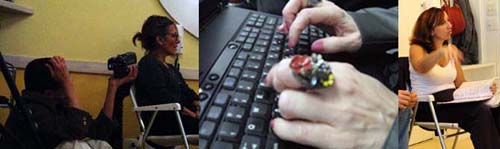
Esse combinado de estratégias permite que se transite da teoria viva para as intervenções clinicas que corrigem rotas do processo formativo dos corpos dentro da cooperação grupal necessária para a sustentação de um ambiente formativo, da produção de linguagem viva para os exercícios que emergem do próprio acontecimento coletivo, para a prática da gramática formativa e do processo de produção do soma subjetivo.
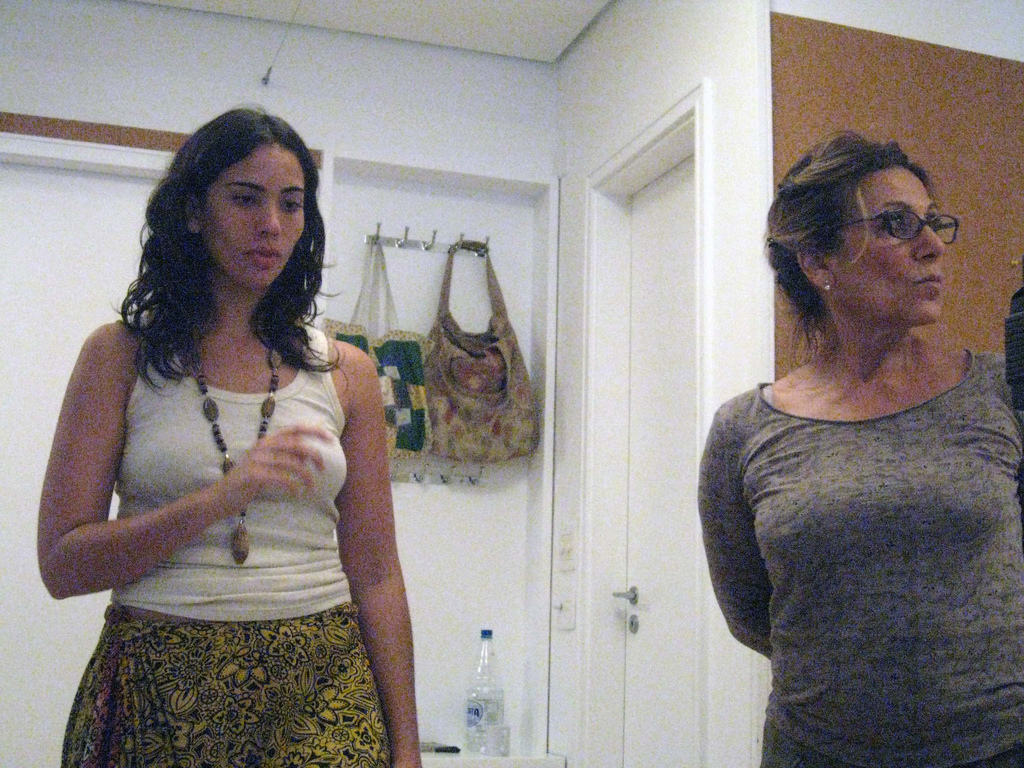
Programa:
1º semestre: Um paradigma formativo onde o modelo do vivo se estende do molecular às formas existenciais dos corpos humanos, sempre dentro das mesmas regras de conectividade e agregação, aprofundando a visão e a vivência do corpo enquanto processador ambiental em continuo processo de produção de si e de ambientes, em conexão com outros corpos.
2º semestre: Uma anatomia capaz de prosseguir formando a partir do vivido ou como os afetos se materializam continuamente em estruturas somáticas ao longo de uma vida em particular segundo a interação das camadas embriogenéticas, numa embriogênese continuada do principio ao fim daquele soma em particular.
3º semestre: O crescimento dos corpos ao longo de seu destino genético, da concepção à velhice, se dá sempre apoiado em interações somáticas que possam vir a oferecer os ambientes confiáveis e os tempos formativos, necessários para que o organismo subjetivo possa se constituir desenvolvendo modos de conexão da fusão até a cooperação.
4º semestre: Os corpos se fazem sempre dentro da história social e seus jogos de poderes e de valores. Como reconhecer e agir formativamente sobre os modos segundo os quais o capitalismo contemporâneo modela vidas, desde suas formas mais precoces até a velhice, recuperando a potência e capacidade pessoal de produzir e sustentar diferença e conexão dentro do ambiente maior, hoje globalizado, com suas características particulares de produção da subjetividade.
A quem se destina: terapeutas corporais das diversas linhas, psicólogos, psicanalistas,terapeutas ocupacionais, artistas, médicos, atores, bailarinos, pessoas ligadas ao estudo e à prática do corpo
Os encontros acontecem a cada dois meses durante um fim de semana inteiro, sábado e domingo, das 10h às 18h.
Vagas: 25
Valor: 600 reais por encontro.
Duração: 4 semestres
Início: segundo semestre de 2012
Degustação para o Seminário de Biodiversidade Subjetiva 2012
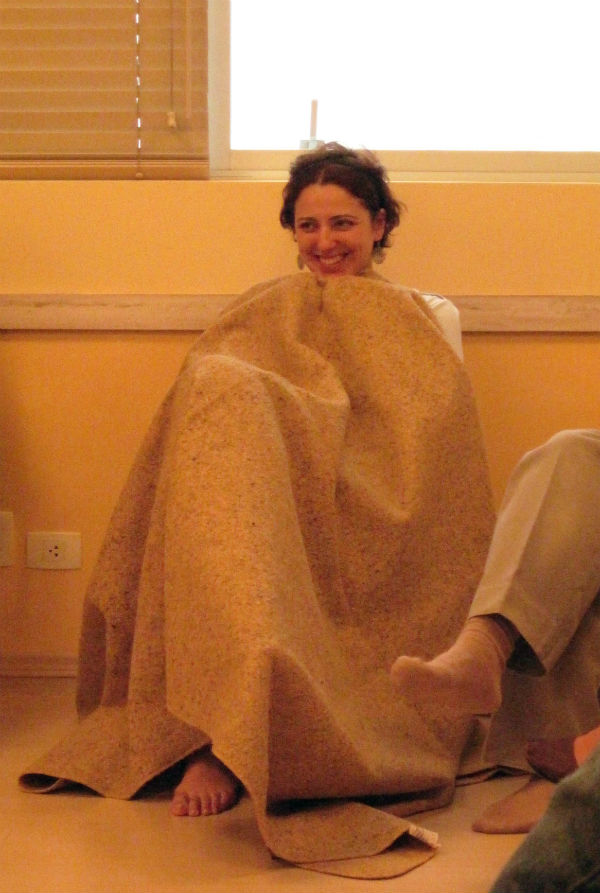
Um processo auto-seletivo para o Seminário de Biodiversidade Subjetiva (clique neste link para saber detalhes): um workshop de experiência com os conceitos, métodos e o dispositivo tecnológico do Laboratório.
Este workshop se destina a pessoas que se interessem em participar dos Seminários de formação que apresentam a visão da Biodiversidade Subjetiva e sua metodologia desenvolvidas por Regina Favre.
O conceito da biodiversidade subjetiva é uma resposta às novas questões da pós-modernidade trazidas pela globalização e seus modos de produção da subjetividade nos corpos.
Antes de uma escolha mais radical por um seminário que dura 4 semestres, é sempre bom saber onde se está colocando os pés.
Data: 18 de agosto de 2012 das 10 às 18h
Local: Laboratório do Processo Formativo
Inscrição: mande seu currículo para [email protected]
Preço: R$ 200,00
Mande seu currículo para Laboratório do Processo Formativo
Rua Apinagés, 1100, cj 507.
Fone: 11-38645785